
Why Buying Organic Herbs in Bulk Saves You More Than Money
Posted by Reese Colbert on 3rd Jul 2026
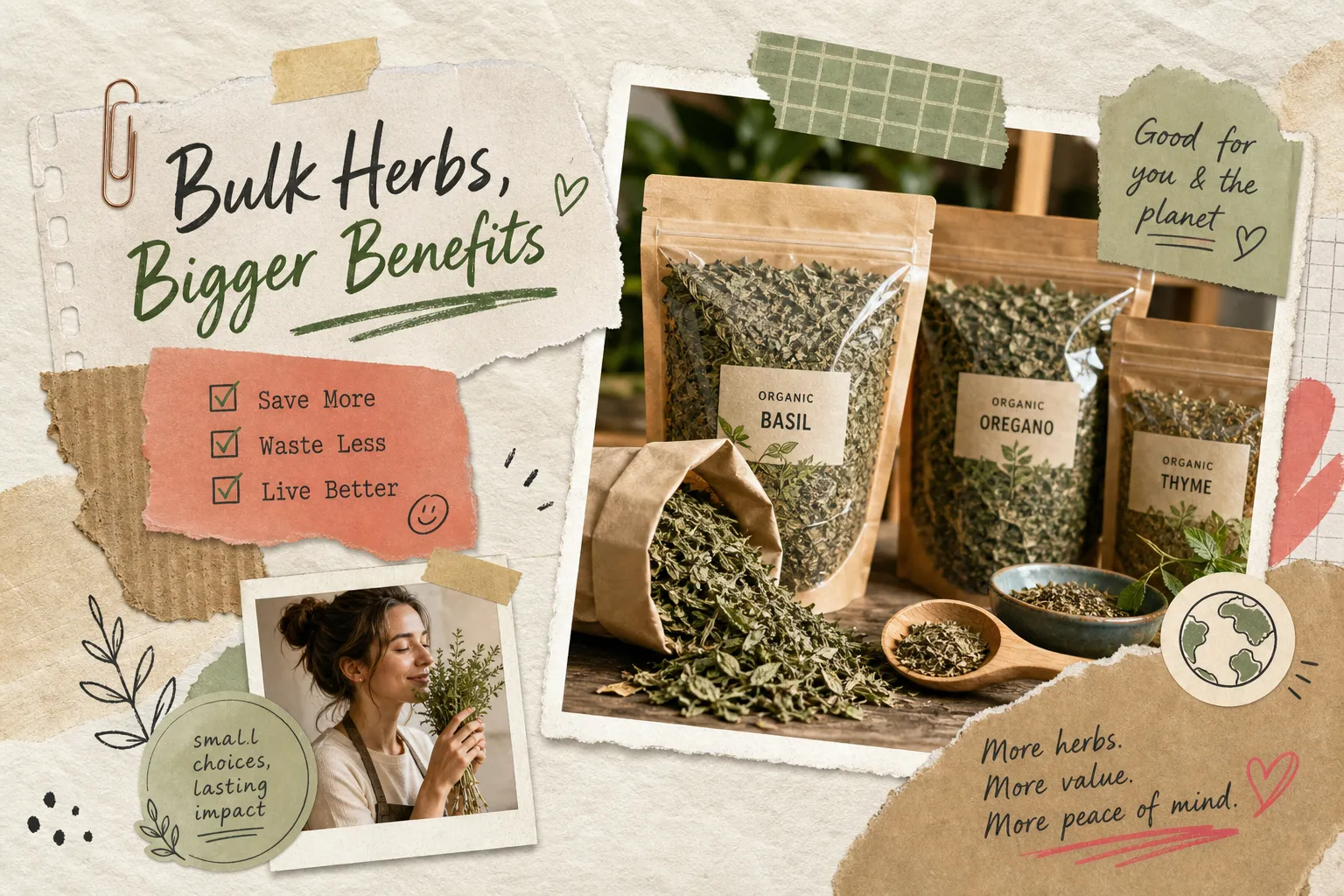
If you've ever found yourself placing a small herb order every couple of weeks, watching the per-unit cost eat into your margins, you're not alone. It's a pattern we see constantly at Herbal Connection, working alongside Australian cafés, naturopaths, food manufacturers and tea retailers for well over a decade. The numbers look manageable week to week, until you add them up across a year and realise how much you've been leaving on the table. Understanding the full benefits of buying organic herbs in bulk is what shifts that calculation for good.
The financial case for switching to bulk is the most obvious starting point, but it's only part of the story. For Australian businesses sourcing from organic herb suppliers, buying certified organic herbs in bulk also changes the quality and consistency of what you're working with, reduces the environmental footprint of your business, and simplifies the operational side of sourcing. Each of these angles compounds quietly in the background while you focus on running your business.
This article unpacks all five of those angles clearly, so you can make a confident, informed decision about whether bulk wholesale sourcing suits where your business is right now.
Benefits of buying organic herbs in bulk: the real cost savings
The financial argument starts with a structural reality: wholesale prices strip out retail markups, individual packaging costs, and the marketing overhead baked into every small packet on a shelf. Industry benchmarking across bulk food markets in Australia and internationally consistently indicates that bulk herbs and spices average around 35% less than their packaged equivalents, with some herbs showing even more dramatic differences. Bay leaves sourced in bulk can cost as little as one-twenty-fourth of the packaged retail price, and thyme shows savings of around 87% when compared at the bulk level. These advantages of buying herbs in bulk accumulate quickly once you move past individual retail packets. Industry discussions on the benefits of buying herbs and spices in bulk echo these savings, and we also go into greater detail in our piece on the advantages of buying organic wholesale herbs.
How per-unit prices shift at wholesale quantities
When a supplier sells to a retailer, every gram of herb has to carry the weight of the retail chain: the packaging design, the label printing, the shelf space, the distribution margin, and the retailer's markup on top. When you order directly from a certified wholesale supplier, those layers disappear. You're paying for the herb, the storage, and the fulfilment, and that's it. The difference per kilogram may seem modest in isolation, but it scales fast across a year of consistent ordering. For a closer look at supply pressures and how to plan for them, see our market highlights on supply chain delays and planning in 2025.
Tiered discount structures: a real-world example
At Herbal Connection, the bulk pricing structure is transparent and straightforward. Spend $500 in a single order and you save 10%. Spend $1,500 and the saving rises to 15%. To illustrate how this compounds: a naturopath ordering a consistent range of certified organic bulk herbs each month, spending $1,500 per quarter, would save $225 each quarter at that tier, $900 back in the business over a year, with no change to the quality of what they're prescribing or selling. A café ordering chamomile, peppermint and lavender for their wellness menu sees the same compounding effect. The savings build quietly without any change to what they're buying or how they use it.
How annual ordering volume changes the total picture
The key shift happens when you stop thinking about price per order and start thinking about price per year. A business that orders quarterly at the $1,500 threshold saves $900 annually, simply by consolidating what they were already buying into less frequent, larger orders. For a café or naturopath in that position, that $900 covers new equipment, extra staff hours, or the cost of trialling additional product lines. It's not a rounding error, it's a deliberate sourcing decision that pays for itself.
Quality and supply chain consistency you can rely on
Price is the entry point, but quality consistency is what keeps businesses coming back to bulk wholesale sourcing. Formulators, food manufacturers and health practitioners can't afford variation between batches. When the potency of your chamomile changes order to order, your product changes too, and that's a problem that compounds quietly until a customer notices.
What certified organic actually means for your product
Certified organic herbs go through rigorous, independent third-party verification. That means no synthetic pesticides, no GMOs, no synthetic fertilisers, and a mandatory three-year conversion period for farmland before the "certified organic" designation is permitted under the National Standard for Organic and Biodynamic Produce, administered by the Department of Agriculture, Fisheries and Forestry (DAFF). For businesses building a product or practice around organic credentials, the traceability chain matters as much as the herbs themselves. Your customers are trusting your label, and your label depends on your supplier's documentation being sound.
Benefits of buying organic herbs in bulk: batch consistency and traceability
When you source in bulk from a single certified organic wholesale supplier, provided they maintain batch traceability from farm to dispatch, you can maintain a consistent sourcing lot across orders. That means the same farm of origin, the same drying methods, the same batch profiles. Always request the certificate numbers, Certificates of Analysis (COAs), and batch records from any supplier you're considering. HACCP certification at the supplier level, as outlined by Food Standards Australia New Zealand (FSANZ), means food safety compliance is built into the supply chain, not bolted on as an afterthought. A quality wholesale supplier provides compliance-ready documentation, which reduces your audit preparation time and removes a significant layer of risk when regulatory or retailer audits arise.
Why small, frequent retail purchases introduce inconsistency
Buying small packets from rotating sources introduces variables that are difficult to control: differences in potency, moisture content, herb origin, and even harvest season. Over time, this inconsistency shows up in your formulations, your menu, and your customer feedback. Consolidating to a single trusted wholesale supplier eliminates that variability and makes your formulations more repeatable and your product more consistent across every batch.
The sustainability case for buying organic herbs in bulk
This is where the "more than money" premise earns its weight. The environmental data on bulk purchasing is specific and compelling, and it matters to a growing number of Australian businesses, particularly those working toward sustainability certifications or marketing to eco-conscious customers.
How packaging waste adds up with retail herb purchasing
Food packaging and containers make up a substantial share of Australia's landfill waste, according to the Australian Packaging Covenant Organisation (APCO). When a business buys 20 individual packets of herbs each month, it generates 20 units of plastic, foil, cardboard, and ink. Switching to a single bulk order in a barrier bag substantially reduces that single-use packaging compared with many small retail packets. Over a year, the difference in packaging waste between retail and bulk purchasing is significant, and for a business tracking its environmental footprint, it's a metric worth calculating.
Transport efficiency and your carbon footprint per order
Buying organic herbs in bulk means fewer deliveries, fewer dispatch runs, and fewer kilometres travelled per kilogram of product received. Consolidating orders into larger, less frequent shipments reduces petrol emissions per unit of herb delivered, a direct reduction in transport-related carbon output. For businesses working toward scope 3 emissions targets or sustainability reporting, this is a meaningful and documentable improvement that requires no operational change beyond adjusting your ordering frequency.
Eco-friendly packaging from wholesale suppliers who care
The environmental benefit doesn't stop at order quantity. Responsible wholesale suppliers are shifting toward biodegradable and compostable packaging at the bulk level, which means your herbs arrive in packaging that aligns with your own sustainability values. At Herbal Connection, our commitment to eco-friendly, biodegradable packaging means businesses receive their certified organic bulk herbs without contributing to single-use plastic waste at the supply end either. Your herbs arrive, the packaging breaks down, and nothing heads to landfill on either end of the transaction.
Certifications and supplier checks every Australian buyer should know
The word "organic" on a product label in Australia carries no legal weight without third-party verification. Any business can call a product organic without any certification at all. This distinction is critical for businesses making claims to their own customers, and getting it wrong carries both reputational and legal risk.
The difference between "organic" and "certified organic" in Australia
Under the Competition and Consumer Act 2010 (Cth), the term "certified organic" is legally protected and requires independent certification from a government-accredited body. A product labelled simply "organic" has no such requirement behind it. Buyers who rely on self-declared organic labels are taking a genuine risk, particularly if they pass those claims on to their own customers through product labelling or marketing. This is one of the less-discussed benefits of buying organic herbs in bulk from a properly certified organic herb supplier in Australia, your documentation trail is built in from the start. For a plain-English outline of the difference between organic and Australian certified organic, see this guide.
Which certifications to look for
DAFF approves a set of certifying bodies in Australia. ACO (Australian Certified Organic) is the largest and most widely recognised, holding the "Bud" logo and accreditation for EU, USDA, JAS and Korean export markets. OFC (Organic Food Chain) is another independent certifier with rigorous standards, particularly suited to small and medium producers. BDRI (Bio-Dynamic Research Institute), also known as Demeter, focuses on biodynamic produce. NASAA Certified Organic (NCO) and Southern Cross Certified (SXC) are also DAFF-approved and actively certifying. When evaluating a supplier, look for the certification number on the product, not just the logo. A number can be verified; a logo alone cannot. For an overview of Australian certification and standards, AustOrganic's resources are a useful reference.
Three practical questions to ask any wholesale herb supplier before ordering
These three questions cut through marketing language quickly. First: can you provide your current organic certification number and the name of your accredited certifying body? Second: do you maintain batch traceability documentation from farm to dispatch? Third: is your facility HACCP-certified? A supplier who hesitates on any of these is worth approaching with caution. A supplier who answers all three immediately and offers to send documentation is the kind of long-term partner your business needs.
Storing bulk organic herbs the right way to protect your investment
The most common hesitation around bulk buying is straightforward: "Will I use it before it goes off?" It's a fair question, and the answer is almost certainly yes, provided you store correctly. With the right conditions, bulk dried organic herbs retain their potency well beyond a single ordering cycle.
How long bulk dried organic herbs actually last
Shelf life varies by category, not by whether you bought in bulk. Dried leafy herbs retain potency for one to three years. Ground spices last two to three years. Whole spices, stored correctly, remain usable for three to five years. Potency, not safety, is what degrades over time in properly stored dry herbs. A business ordering quarterly or even semi-annually is comfortably within the usable window for most products in their range. Industry sources on how long dried herbs last provide comparable timelines and practical notes.
The storage conditions that preserve potency and flavour
Airtight containers are non-negotiable. Store bulk herbs between 15°C and 21°C, away from heat sources, moisture, and direct light. Dark glass jars work well for smaller quantities; opaque polyfoil barrier bags are the preferred format for bulk stock. Ground forms lose potency faster than whole forms due to increased surface area, so buying whole and grinding as needed is a smart strategy for high-use herbs where freshness is critical to the end product. Keep your main bulk stock sealed and divide into smaller working containers to minimise how often the primary supply is opened and exposed to air. For more detailed storage recommendations, see the UC Davis produce fact sheet on fresh culinary herbs.
A simple potency check before you reorder
Before you place your next bulk order, do a quick sensory check on your current stock. Take a small pinch of the herb, crush it between your fingers, and assess the strength of the aroma. A strong, clear fragrance means the batch still has good potency. If the scent is faint or flat, the herb is past its best and it's time to reorder. This crush-and-smell method requires no equipment and takes seconds, a reliable, low-tech way to manage your bulk supply without waste or guesswork.
Making the switch: your next step
The benefits of buying organic herbs in bulk come together across five genuine business advantages: lower cost per kilogram that compounds into real annual savings, consistent batch quality that makes formulation and menu planning more reliable, reduced packaging and transport waste that supports your sustainability commitments, a clear certification framework that protects your business and your customers, and storage conditions that make bulk quantities genuinely low-risk to manage.
Start by calculating your average monthly herb spend. If you're reaching the $500 threshold across your regular orders, consolidating into a single bulk order immediately triggers a 10% saving. If you're approaching $1,500 quarterly, the 15% tier adds $900 back into your budget annually, with no change to what you're buying or how you're using it.
At Herbal Connection, we've built our business around making bulk certified organic sourcing straightforward for Australian businesses: transparent pricing, HACCP-certified facilities, eco-friendly biodegradable packaging, and the kind of personalised B2B service you get from a family-owned operation that genuinely wants to see your business grow. If you're ready to review your herb sourcing or simply want to explore what buying organic herbs in bulk looks like for your specific range, reach out to our team. We're here to help you get it right from the first order. You can also read more about why Australian brands choose organic bulk herbs and teas to see examples of how local businesses have made the transition successfully.