Goji berries are a nutritious healthy snack. Eat them as they are or add them to your favourite trail mix, cereal, muesli or smoothie. Soaked in hot water they make a wonderful tea.
Black Goji Berries Organic — Lycium ruthenicum, China
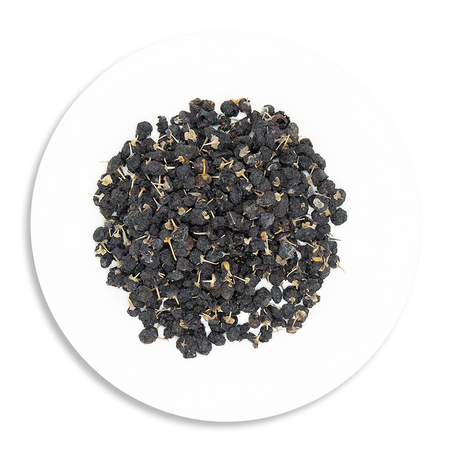
Certified Organic Black Goji Berries (Lycium ruthenicum) — whole sun-dried black goji berries from certified organic cultivation in China. Black goji berries are a genuinely distinct species from the familiar red goji berry: where red goji is Lycium barbarum, black goji is Lycium ruthenicum — a related but separate species of the Solanaceae family that produces much smaller, darker berries with a completely different pigment profile and flavour character. The black goji is native to the arid and semi-arid regions of northwestern China, Xinjiang province, and Central Asia, where it grows wild in harsh, alkaline soils; the growing conditions contribute to the berry's unusually high anthocyanin concentration.
The defining characteristic of black goji berries is their extraordinary anthocyanin pigment content — specifically delphinidin-based anthocyanins — which produces their deep dark purple-black colour and, crucially, makes them pH-reactive: the berry infuses to a deep blue-purple in alkaline or neutral water, and shifts dramatically toward pink-red in acidic conditions. This colour-shifting behaviour is the primary distinguishing feature that drives interest from premium tea blenders, food colourant applications, and specialty beverage formulations. The flavour is notably different from red goji — less sweet-tart, more subtly earthy and slightly bitter, with a milder overall intensity. Certified organic. 5% discount on orders of 20–100 units. Available 250g to 5kg bulk. This product is sold as a food only.
StorageBelow 23°C in a sealed, dry, dark, airtight container
Black Goji Berries — FAQs
Everything you need to know before you order.
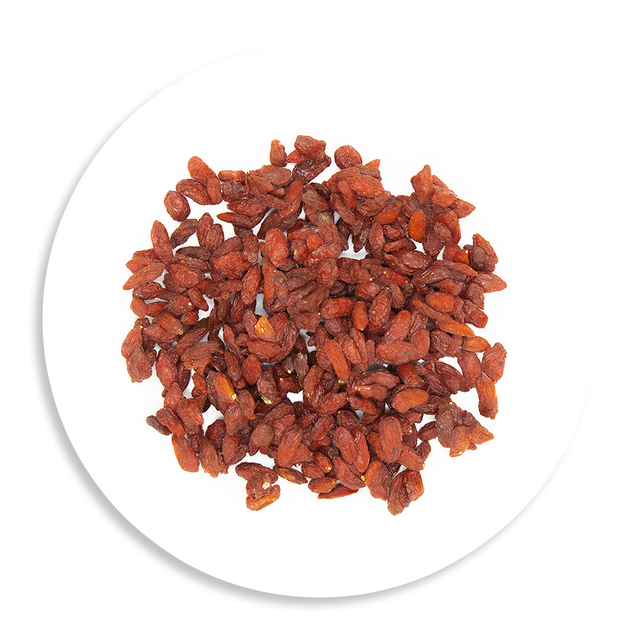
Black and red goji berries are different species — not just different colours of the same plant. Red goji (Lycium barbarum) is the widely cultivated, commercially dominant species — larger, sweeter-tart, vivid orange-red colour, broadly available. Black goji (Lycium ruthenicum) is a separate, less commonly cultivated species native to the harsh arid regions of northwestern China, Xinjiang, and Central Asia — significantly smaller berries, dark purple-black colour, much more subtle flavour (less sweet, slightly earthy), and an extraordinarily different pigment profile based on anthocyanins rather than the carotenoids that give red goji its colour. The two species are related (both in the Lycium genus, Solanaceae family) but produce berries with fundamentally different characteristics. The price premium of black goji reflects its relative rarity, more challenging cultivation conditions, and the commercial interest in its distinctive pH-reactive colour behaviour.
Black goji berries contain very high concentrations of delphinidin-based anthocyanins — the same family of pigments responsible for the colours of red cabbage, blue cornflower, and some other deeply coloured plants. These pigments are pH-sensitive: in alkaline or neutral water (pH 7 or above), the infusion is a striking deep blue-purple; as the pH decreases toward acidic conditions (pH below ~6), the colour shifts progressively toward violet, then pink, then bright red-pink. In practice: steep black goji in plain tap water or filtered water (typically slightly alkaline to neutral) and the liquid turns a deep purple-blue. Add a few drops of lemon juice or any acidic ingredient and the colour visibly shifts toward pink-red in real time. This behaviour makes black goji berries of particular interest to premium tea blenders, specialty beverage formulators, and culinary applications where a colour-shifting visual effect is a product feature. The colour change is a natural chemical property of the anthocyanins — not a processing step or additive.
Premium loose leaf tea: black goji berries brew a visually spectacular deep purple-blue infusion in neutral or slightly alkaline water — highly appealing as a standalone single-ingredient tea or blended with other botanicals. Add lemon or citrus to the cup and the colour visually shifts toward pink-red, creating a dramatic effect that has made black goji tea a premium specialty item in Asian tea culture and increasingly in Western specialty tea markets. Iced tea and cold beverages: cold-brew in neutral water for a striking coloured iced tea; serve with a lemon wedge on the side to allow the colour shift at the table — an engaging hospitality presentation. Cocktails and mocktails: the pH-reactive colour change is a well-established visual effect in specialty cocktails and mocktails — use black goji-infused water as a base that shifts colour when citrus or acidic mixers are added. Food and beverage manufacturing: black goji extract functions as a natural blue-purple food colourant that can be modulated toward pink-red with pH adjustment — relevant for manufacturers seeking natural colourant alternatives.
Black goji berries taste noticeably different from red goji berries, and buyers should be aware of this before purchasing as a flavour-forward ingredient. Where red goji is characteristically sweet-tart and relatively flavourful, black goji has a much more subtle and less assertive character — mild, slightly earthy, a touch bitter, with only faint sweetness. The berries themselves eaten raw are small and chewy with an understated flavour that most people would not describe as strongly flavoured. The tea infusion is similarly mild in flavour — the visual impact and colour far exceeds the flavour impact. In blended teas and beverages, other ingredients typically provide the primary flavour while the black goji contributes its distinctive colour. Buyers purchasing primarily for flavour rather than colour would likely find red goji (conventional or organic) more suitable at a significantly lower price point.
Yes — like red goji, Lycium ruthenicum is a member of the Solanaceae (nightshade) family. Individuals following a strict nightshade-exclusion diet should note this botanical classification. The product contains no known declared allergens. No sulphites are declared for black goji (unlike red goji, which has a declared sulphite level) — however, this should be confirmed on current batch CoA documentation, and buyers producing finished food products should contact us to obtain current allergen documentation before formulating. The Herbal Connection makes no allergen-free claims.
The standard sizes listed — 250g, 500g, 1kg, and 5kg — are our regular stocked wholesale pack sizes, with a 5% volume discount for orders of 20–100 units. The Herbal Connection is a wholesale supplier and can accommodate bulk orders beyond standard sizes for buyers with ongoing requirements. Black goji is a premium product — for buyers who need a more accessible price point or do not require the pH-reactive colour property, the Goji Berry Whole Organic (HTO.GOJIWK1) and Goji Berry Whole (FR.GOJIK1) are also available. Contact our wholesale team at sales@herbalconnection.com.au to discuss your specific requirements.
About
Our Organic Whole Goji Berries are naturally sun-dried and sourced from certified organic farms in China. Packed with vibrant colour and a sweet-tart flavour, goji berries are an ancient...
Description:Goji berries are a nutritious healthy snack. Eat them as they are or add them to your favourite trail mix, cereal, muesli or smoothie. Soaked in hot water they make a wonderful tea. ...
About
Our Organic Goji Berry Powder is made from premium freeze-dried goji berries sourced from China, then milled to a fine, nutrient-rich powder. Known for their naturally vibrant colour and...
About
Organic Hawthorn Berries, sourced from pristine regions, are renowned for their numerous health benefits. These berries are known for supporting heart health, improving circulation, and...
Vitex agnus-castus Origin: Albania Chasteberry is frequently utilized by natural health practitioners to reduce a male’s testosterone levels and to control hormone imbalances in females. It’s...