
Devil's Claw: The Story of a Fierce-Looking Herb from the Kalahari
Posted by Reese Colbert on 25th Sep 2025
Devil's Claw: The Story of a Fierce-Looking Herb from the Kalahari
Nature has a flair for the dramatic, and few plants embody this better than Devil's Claw. With a name that evokes images of something fierce and formidable, this unique herb is a testament to the harsh, beautiful landscape from which it comes—the Kalahari Desert of Southern Africa. Its story is one of survival, traditional knowledge, and a fascinating journey from the desert sands to the pages of modern herbalism.
Today, we're exploring the botanical and historical world of Devil's Claw Root Powder (Harpagophytum procumbens). This is not a guide for consumption, but an educational journey into a plant with a rich ethnobotanical history and a truly unforgettable appearance.
Important Notice: For Educational Use Only
The information in this article is for educational and historical context only. The Devil's Claw powder sold by The Herbal Connection is intended strictly as a raw botanical specimen for identification, research, or educational purposes. It is not sold for human consumption. Any consideration of using this herb should be done under the direct supervision of a qualified healthcare professional or registered herbalist.
The Story Behind the Fierce Name
Devil's Claw gets its memorable name not from the root, which grows underground, but from its peculiar fruit. The plant produces a large, woody capsule that is covered in long, grappling arms, each ending in a sharp, hooked claw. This is a remarkable evolutionary adaptation. When the fruit dries, these arms spread out, lying in wait on the desert floor.
When a grazing animal steps on the fruit, the hooks latch onto its hoofs or fur. The animal's panicked movements as it tries to dislodge the painful fruit only serve to break the capsule apart, effectively dispersing the seeds far and wide. While ingenious, it's this tenacious, claw-like grip that earned the plant its devilish moniker.
A Root of Deep Tradition
While the fruit is visually striking, the true value of the plant in traditional herbalism lies in its roots. The plant has a primary taproot, but it also develops secondary storage roots, or tubers, that grow deep underground to store energy and water for surviving long droughts. It is these secondary tubers that are harvested.
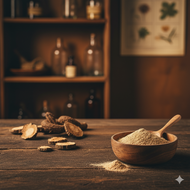
For centuries, the Indigenous San and Khoi peoples of the Kalahari have held this plant in high regard. They would dig up the tubers, slice them, and dry them in the hot sun. The dried slices would then be ground into a powder. This powder was a cornerstone of their traditional medicine, most commonly prepared as a bitter tea or infusion. It was used for a vast array of purposes, from addressing digestive complaints to acting as a general pain reliever and fever reducer.
The Power of Bitterness
The defining characteristic of a Devil's Claw infusion is its profound and intense bitterness. This is not a subtle flavour; it is one of the most powerful bitters in the herbal world. This taste is a direct indicator of its active constituents, primarily a group of compounds called iridoid glycosides, with the most famous being harpagoside.
In many traditional healing systems, bitter herbs are considered essential for good health. The bitter taste on the tongue is thought to trigger a reflex that stimulates the entire digestive system, increasing the production of saliva, digestive enzymes, and bile. This is why so many traditional "digestive tonics" are intensely bitter, and Devil's Claw was a classic example of such a preparation.
From the Kalahari to the World
The story of how Devil's Claw reached the global stage is a fascinating piece of ethnobotanical history. In the mid-20th century, a German farmer named G.H. Mehnert, living in Namibia, observed local people using the plant. Intrigued, he learned about its preparation and began to study it, eventually leading to its introduction into European herbalism, where its popularity exploded, particularly in Germany and France.
Today, it is one of the most well-known and commercially successful herbal exports from Africa. This has also led to important conversations around sustainability and ethical harvesting to ensure the wild populations of this slow-growing plant are not over-exploited and that the Indigenous communities who are the original knowledge-keepers benefit from its commercialisation.
A Botanical Specimen of Note
Devil's Claw is a powerful and historically significant plant. Its journey from the Kalahari sands to apothecaries worldwide is a testament to the enduring value of traditional herbal knowledge. As a raw botanical, our Devil's Claw Powder offers an opportunity to study and appreciate this unique specimen—its fine texture, its characteristic aroma, and its connection to the rich biodiversity and cultural history of Southern Africa.