
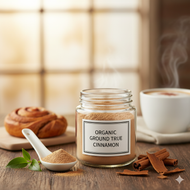
The "True" Cinnamon: Why You Need to Switch to Organic Ceylon Powder
Posted by Reese Colbert on 18th Nov 2025
The "True" Cinnamon: Why You Need to Switch to Organic Ceylon Powder
You know the smell of cinnamon. It's the spicy, hot, pungent aroma of a fireball candy or a heavy Christmas decoration. But what if we told you that's not "true" cinnamon? Prepare to rediscover a spice you thought you knew. We're diving deep into Organic Ground Ceylon, the real, delicate, and sweet alternative.
Introduction: The Great Cinnamon Impostor
For most of our lives, the cinnamon we've bought from the supermarket has been a lie. Not a malicious one, but a case of mistaken identity that has shaped our palates for generations. The robust, spicy, reddish-brown powder we stir into our oats or see in cinnamon sticks is almost always **Cassia** (*Cinnamomum cassia*). It's a perfectly fine spice—bold, pungent, and cheap. But it is not, by definition, "true cinnamon."
The title of "True Cinnamon" belongs to a completely different species: **Cinnamomum zeylanicum**, also known as *Cinnamomum verum* ("verum" literally means "true") or, more commonly, **Ceylon Cinnamon**. When you buy Organic Ground True Cinnamon, you are buying this premium, authentic product.
This isn't just a case of botanical nitpicking. The difference in flavour, aroma, and—most importantly—chemical composition is staggering. While Cassia is a brute-force spice of fiery heat, Ceylon is a delicate, sweet, and complex spice of aromatic finesse. This is a guide to the spice you *thought* you knew, and why upgrading your pantry is one of the best moves you can make.
Chapter 1: Cassia vs. Ceylon - A Tale of Two Cinnamons
Understanding the difference between these two "cinnamons" is the key. They are cousins, both from the *Cinnamomum* genus, but they come from different trees, different places, and are harvested in completely different ways.
The Impostor: Cassia Cinnamon (What You Probably Have)
- Species: Cinnamomum cassia (or *C. burmannii*).
- Origin: Primarily China, Vietnam, and Indonesia.
- Appearance: A single, thick, woody layer of bark. Sticks are extremely hard and difficult to grind. Powder is a deep, dark reddish-brown.
- Flavour: Pungent, spicy, and "hot." The flavour is very direct and one-dimensional, dominated by the compound *cinnamaldehyde*. This is the classic "cinnamon fireball" taste.
The Original: Organic Ceylon Cinnamon (This Product)
- Species: Cinnamomum zeylanicum or Cinnamomum verum.
- Origin: Primarily Sri Lanka (formerly Ceylon), grown organically.
- Appearance: Made of many paper-thin layers of inner bark, rolled into a fragile "quill." Powder is a pale, light tan-brown.
- Flavour: Delicate, sweet, and highly aromatic. It has a complex, warm flavour with subtle notes of citrus and flowers. It is *not* spicy. The flavour is sophisticated.
Chapter 2: The Most Important Difference: The Coumarin Question
If you take away only one thing from this article, let it be this. The primary chemical difference between Cassia and Ceylon is a compound called **coumarin**.
Coumarin is a natural flavouring substance. However, in moderate to high doses, it is a known **hepatotoxin**, meaning it can cause liver damage or toxicity in sensitive individuals. This is not a risk to be taken lightly, especially for people who consume large amounts of cinnamon daily (for example, in smoothies, lattes, or for health purposes).
This is where the distinction becomes critical:
- CASSIA (The Impostor) is **VERY HIGH** in coumarin. Studies show Cassia powder can contain anywhere from 0.3% to 1.2% coumarin by weight. Just one or two teaspoons of Cassia powder can put a person over the "Tolerable Daily Intake" (TDI) set by health agencies.
- CEYLON (The True) is **EXTREMELY LOW** in coumarin. It contains only trace, negligible amounts—often around 0.004%. This is thousands of times less than Cassia.
For this reason alone, **Organic Cinnamon Zeylanicum (Ceylon) is the only choice for regular, daily consumption.** It provides all the aromatic pleasure of cinnamon with virtually none of the coumarin risk.
Chapter 3: Why Organic?
When you're consuming the bark of a tree, you're consuming the part that acts as its filter. Choosing Organic Cinnamon Powder ensures that the *Cinnamomum zeylanicum* trees were grown without the use of synthetic pesticides, herbicides, or fertilisers. This means the powder you're stirring into your daily coffee or smoothie is as pure and clean as possible, free from unwanted chemical residues.
Chapter 4: How to Use Ground Ceylon Cinnamon
Because its flavour is delicate, the rules for using Ceylon are different from those for Cassia. While Cassia can stand up to a bold, spicy gingerbread, Ceylon shines in dishes where you want the cinnamon to *complement* other flavours, not *overpower* them.
Perfect for Beverages (Its Superpower)
This is Ceylon's killer app. Its fine grind and sweet, non-spicy flavour make it the ultimate powder for:
- Lattes & Cappuccinos: Dust it on top. It won't give you that harsh, spicy "challenge" feeling.
- Chai Tea: It provides the authentic, warm, aromatic base of a true Masala Chai.
- Hot Chocolate: It adds a sophisticated, fragrant note that cuts through the richness of the cocoa.
- Daily Smoothies: The perfect, liver-safe choice for your daily health smoothie.
Elevated Baking & Desserts
Use Ceylon where you want a "finesse" flavour:
- Custards & Puddings: Essential for rice pudding or a crème brûlée, where Cassia would be far too harsh.
- Biscuits: Perfect for delicate shortbread or sugar cookies.
- Breakfast: The absolute best for dusting on French toast, pancakes, or fresh fruit (like baked apples) as it adds sweetness without the spice.
Savoury Uses
The subtle, sweet warmth of Ceylon is a secret weapon in many savoury dishes:
- Moroccan Tagines: A key ingredient with chicken or lamb, blending with apricots and almonds. *
- A pinch adds an incredible, unexpected depth and aroma. *
- Many authentic mole recipes call for a hint of "true" cinnamon (not Cassia) to provide a complex background note.
Substitution Tip: If you're adapting a recipe that expects the harshness of Cassia, you may need to use **about 1.5x the amount** of Ceylon powder to get the same flavour intensity.
Conclusion: An Upgrade for Your Palate (and Your Liver)
Making the switch to Organic Ground True Cinnamon is one of the easiest and most impactful upgrades you can make in your pantry. You are not simply swapping one brand for another; you are swapping an entirely different spice.
You gain a sophisticated, sweet, and complex flavour profile that will elevate your baking and beverages. More importantly, you gain peace of mind, knowing you are using the "true" cinnamon that is celebrated for its flavour, not the one that carries a risk of toxicity.
This is the cinnamon you've been missing. It's time to discover the sweet, subtle, and safe secret of the "joy of the mountain."
Ready to upgrade your pantry? You can find our premium Organic Ground True Cinnamon here.
Disclaimer: This information is for educational purposes only and is not intended to diagnose, treat, cure, or prevent any disease. This product is sold as a food only. Please consult with a qualified healthcare professional before use.