
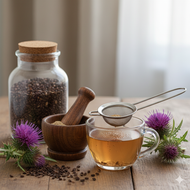
The Liver Herb: A Guide to St. Mary's Thistle (Milk Thistle) & Silymarin
Posted by Reese Colbert on 18th Nov 2025
The Liver Herb: A Guide to St. Mary's Thistle (Milk Thistle) & Silymarin
It's the striking purple flower you see on roadsides, but its true power lies in its hard, dark seeds. We explore the 2,000-year history of St. Mary's Thistle (Milk Thistle), its link to 'Silymarin', and the *only* correct way to prepare the whole seeds to unlock their benefits.
Introduction: The Legendary Liver Tonic
If one herb, above all others, is famously associated with the liver, it's this one. For over 2,000 years, from the time of ancient Greek physicians to modern-day herbalists, the seeds of this prickly plant have been the cornerstone of traditional European medicine for liver support.
You may know it as St. Mary's Thistle or, more commonly, Milk Thistle. The names are interchangeable, and the legend is potent. But the power isn't in the flower or the leaves—it's locked inside the extremely hard, dark Whole Seeds. This is also the most common mistake people make: you can't just brew these seeds like a normal tea.
This guide will clear up the confusion. We'll explain what St. Mary's Thistle is, what "Silymarin" means, and the critical step you *must* take to properly prepare the whole seeds at home.
Chapter 1: St. Mary's vs. Milk Thistle (What's in a Name?)
Let's clarify the names. They are the same plant.
- Botanical Name: *Silybum marianum*
- Common Name 1: Milk Thistle
- Common Name 2: St. Mary's Thistle
The plant is a tall, striking thistle with a bright purple flower and sharp, spiny leaves. The leaves are its most distinctive feature, with unique white veins running through them. Legend tells that these milky-white veins are an "irrefutable signature of the Virgin Mary's milk," which is where both the names "St. Mary's Thistle" and "Milk Thistle" come from.
This "milky sap" from the leaves was used in the past, but herbalists quickly learned that the true power of the plant was concentrated in its small, hard, dark-brown or black seeds (which are technically the fruit, called an achene).
Chapter 2: The Treasure Inside the Seed: What is Silymarin?
This is the most important part to understand. When you buy a "Milk Thistle" supplement, you are not buying the whole plant; you are buying an extract of the seed, standardized for one thing: **Silymarin**.
Silymarin is not a single compound. It is a group of active flavonolignans found *inside* the hard shell of the milk thistle seed. This silymarin complex is the "active ingredient" that has been the subject of thousands of scientific studies and is directly linked to the herb's traditional use for liver health.
This presents a unique problem. The very compounds you want are locked inside a seed shell that is, quite literally, rock-hard. Simply swallowing the whole seeds or steeping them in tea will do almost nothing, as your body (and the water) cannot break them down.
Chapter 3: How to Use Whole Milk Thistle Seeds (The Critical Step)
You *must* break the seed open. A simple infusion in a teapot is a waste of good seeds. You have two main options.
Method 1: Grind Them (The Best Way)
This is the most effective method by far.
- Place your Whole St. Mary's Thistle Seeds into a powerful coffee grinder, spice grinder, or a high-speed blender (like a Vitamix or Blendtec). A small mortar and pestle will also work, but it takes significant effort.
- Grind the hard seeds into a coarse or fine powder. This powder is now "active" and ready to use.
- Storage: Once ground, the oils in the seed are exposed to oxygen. Store the ground powder in an airtight container in the fridge and try to use it within a week or two. It's best to grind only what you need.
How to use the ground powder:
- In a Smoothie: This is the easiest way. Add 1 teaspoon of the powder to your daily smoothie.
- As a Tea: Add 1-2 teaspoons of the powder to a tea infuser or plunger. Pour over hot (not boiling) water, cover, and let steep for 10-15 minutes. Note: The tea will be cloudy, and you'll need a fine filter.
- Sprinkled: You can sprinkle the ground powder directly onto your muesli, yoghurt, or porridge.
Method 2: The Decoction (If You Have No Grinder)
If you can't grind the seeds, you must boil them to extract the compounds.
- First, try to at least crush the seeds. Place them in a durable bag and *carefully* hit them with a hammer or a rolling pin to crack them open.
- Add 1 tablespoon of the crushed seeds to 2 cups of cold water in a small pot.
- Bring to a boil, then reduce the heat to a low, gentle simmer.
- Simmer, partially covered, for 15-20 minutes. The liquid will reduce and turn a brownish colour.
- Strain through a fine-mesh sieve and drink.
Chapter 4: What Does It Taste Like?
Milk Thistle is not a "flavour" herb like mint or ginger. Its taste is very mild, earthy, slightly bitter, and a little oily (due to the high oil content of the seeds). It's generally not considered unpleasant and is easily hidden in a smoothie or masked with a bit of honey in a tea.
Chapter 5: A Critical Allergy & Safety Warning
St. Mary's Thistle (Milk Thistle) is a proud member of the **Asteraceae (daisy) family**. This is the same family as ragweed, chamomile, marigolds, and echinacea.
If you have a known allergy to ragweed or any of these related plants, you have a higher chance of being allergic to Milk Thistle. Do not consume it.
Furthermore, because of its traditional use in supporting the liver, Milk Thistle can, in theory, affect how your body processes certain medications. It is **essential** to consult your healthcare professional before using it if you are pregnant, breastfeeding, or on any medication at all.
Conclusion: The Power is in the Grinding
St. Mary's Thistle has earned its 2,000-year reputation as a key herbal tonic. But unlike a simple flower or leaf, its power is locked away inside a fortress of a seed. By understanding that these seeds must be ground or decocted, you can effectively incorporate this ancient herb into your modern wellness routine.
Ready to try it for yourself? You can find our high-quality St. Mary's Thistle (Milk Thistle) Whole Seeds here.
Disclaimer: This information is for educational purposes only and is not intended to diagnose, treat, cure, or prevent any disease. This product is sold as a food only. Always consult a qualified healthcare professional before use, especially if you are on medication or have an allergy to the Asteraceae (daisy/ragweed) family.